The GEO Stack: Where Infrastructure Meets Content Strategy
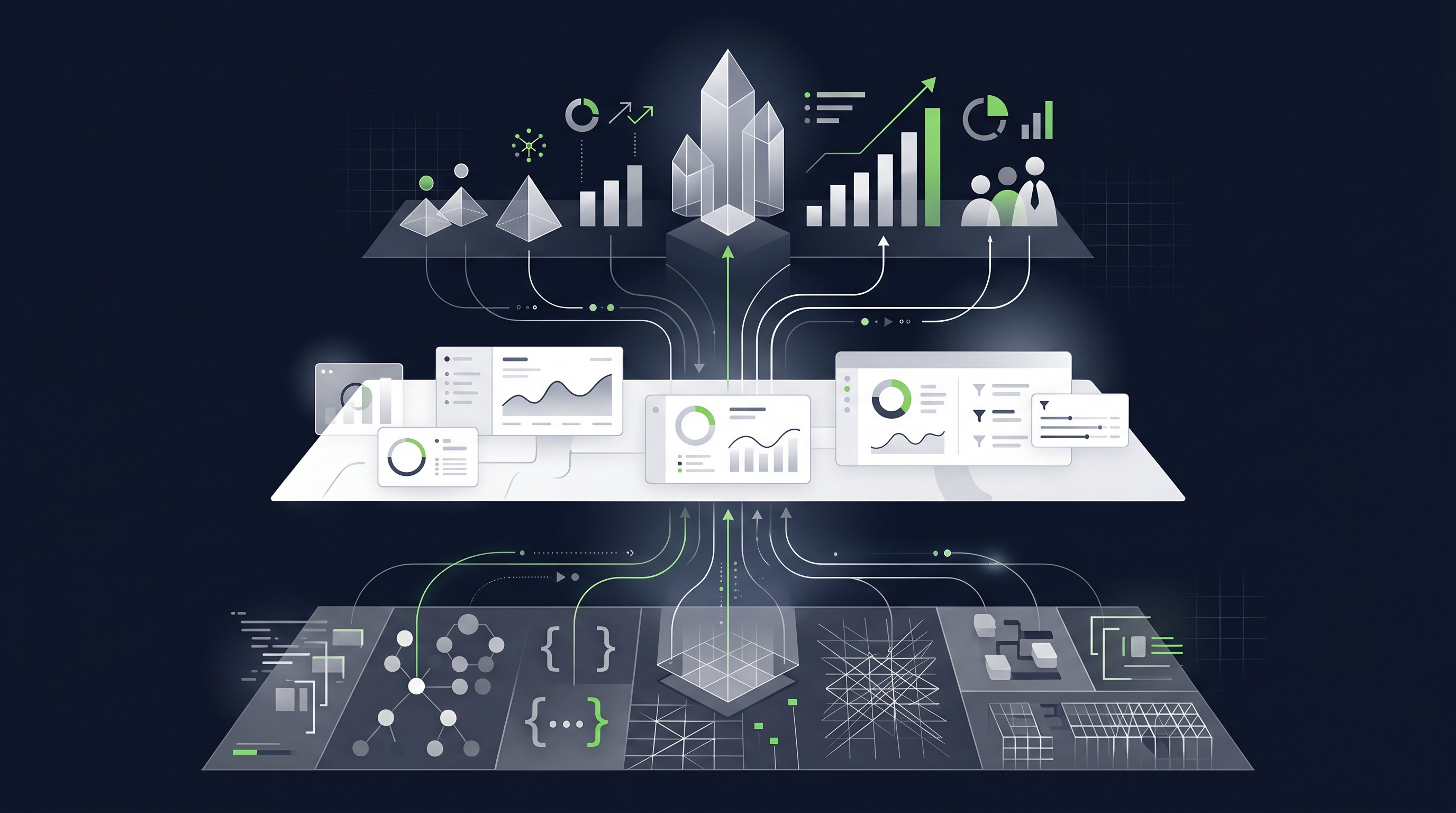
Generative Engine Optimization is not one discipline. It's three — infrastructure, content, and monitoring — stacked in a specific order. Most businesses start in the middle. The ones that succeed start at the bottom.
The GEO market has matured rapidly. In the space of eighteen months, it has gone from an academic concept — coined by researchers at Princeton and Georgia Tech in late 2023 — to a category with its own conference series, dedicated VC-backed platforms, and coverage from every major marketing publication.
With that maturity comes specialisation. Different tools solve different parts of the problem. Understanding which part you need — and in what order — is the difference between a productive GEO investment and wasted effort.
Layer 1: Infrastructure
The infrastructure layer answers a simple question: can AI systems accurately identify your business?
This layer covers structured data (JSON-LD with Organisation schema, sameAs properties, logo declarations), technical accessibility (robots.txt configuration, sitemap presence, HTML validity), and external evidence consistency (whether search results, directory listings, and business profiles corroborate your on-site identity claims).
Infrastructure is invisible to your customers. They never see your JSON-LD. They never interact with your robots.txt. But AI systems interact with nothing else. When a crawler visits your site, the infrastructure layer is the first — and often the only — thing it evaluates.
This is where AI Search Central operates. We audit the infrastructure layer, score it deterministically, and deliver corrections via server-side schema injection. Our AI Visibility Score is, in practical terms, a GEO readiness score for layer 1.
Layer 2: Content
The content layer is where most GEO investment currently goes, and for good reason — it's where the creative leverage is highest.
Content-level GEO involves structuring articles with question-format headings that match how AI systems decompose queries. It means writing with citation-friendly precision — specific data, clear attributions, authoritative voice. It means building topical authority through depth rather than breadth, so AI systems associate your brand with specific knowledge domains.
Content platforms like Frase, Clearscope, and similar tools help writers optimise for these signals. GEO-specific content agencies have emerged to help businesses build libraries of citation-optimised material.
All of this works — when the infrastructure layer is in place. Content that isn't backed by verified entity data gets attributed less reliably. The AI system may cite your content but associate it with the wrong business, or cite it without linking back to you, or simply fail to connect your content to your brand entity because it never had a confident entity declaration to begin with.
Layer 3: Monitoring
The monitoring layer tracks outcomes. How often is your brand mentioned in AI responses? Which LLMs cite you? What do they say? How do you compare to competitors?
Monitoring platforms like Evertune, Gauge, and others have built sophisticated analytics for AI visibility — tracking brand mentions across ChatGPT, Perplexity, Claude, Gemini, and Google AI Overviews. Some test thousands of prompts to map how different AI systems represent a brand across different query types.
Monitoring is essential for understanding whether your GEO investments are working. But monitoring without infrastructure is like tracking website traffic without a website. You're measuring outcomes you can't influence because the foundation isn't in place.
The dependency chain
The three layers have a strict dependency relationship.
Infrastructure enables content. Verified entity data gives AI systems confidence in who you are, which means your content gets attributed correctly when it is cited.
Content drives monitoring signals. Citation-optimised material gives you something to measure. Without content worth citing, monitoring tools report an empty picture.
Monitoring informs infrastructure. Citation analytics can reveal identity gaps — situations where AI mentions your services but attributes them to a competitor, or where your brand is cited in one market but absent in another. These insights feed back into infrastructure improvements.
The stack is a cycle, but it starts at the bottom. You can't run it in reverse.
Where most businesses go wrong
The typical GEO journey looks like this: a marketing team reads about GEO, subscribes to a monitoring platform, discovers their brand isn't being cited by AI, and immediately invests in content optimisation. Three months later, citations haven't improved meaningfully, and the team concludes that GEO "doesn't work yet" for their category.
What they missed is layer 1. Their website has no Organisation schema. Their JSON-LD is a minimal WebPage declaration auto-generated by a CMS plugin. Their business name appears differently in their structured data than it does in their Google Business Profile. Their sameAs properties don't exist.
The AI systems encountering their content can't confidently connect it to their business entity. So even well-written, citation-optimised articles get attributed ambiguously or not at all.
A practical starting point
Before committing budget to content optimisation or monitoring platforms, run a diagnostic on your infrastructure layer. An AI visibility audit takes less than 60 seconds and will tell you exactly where your structured data gaps are.
If your Identity Clarity score is low — missing Organisation schema, absent sameAs properties, no logo declaration — fix those first. The return on that investment will outperform any content-level GEO tactic you could deploy on a broken foundation.
Once the infrastructure is solid, layer 2 becomes dramatically more effective. And once layer 2 is producing citable content, layer 3 gives you the feedback loop to continuously improve.
The GEO stack works. You just have to build it in the right order.